











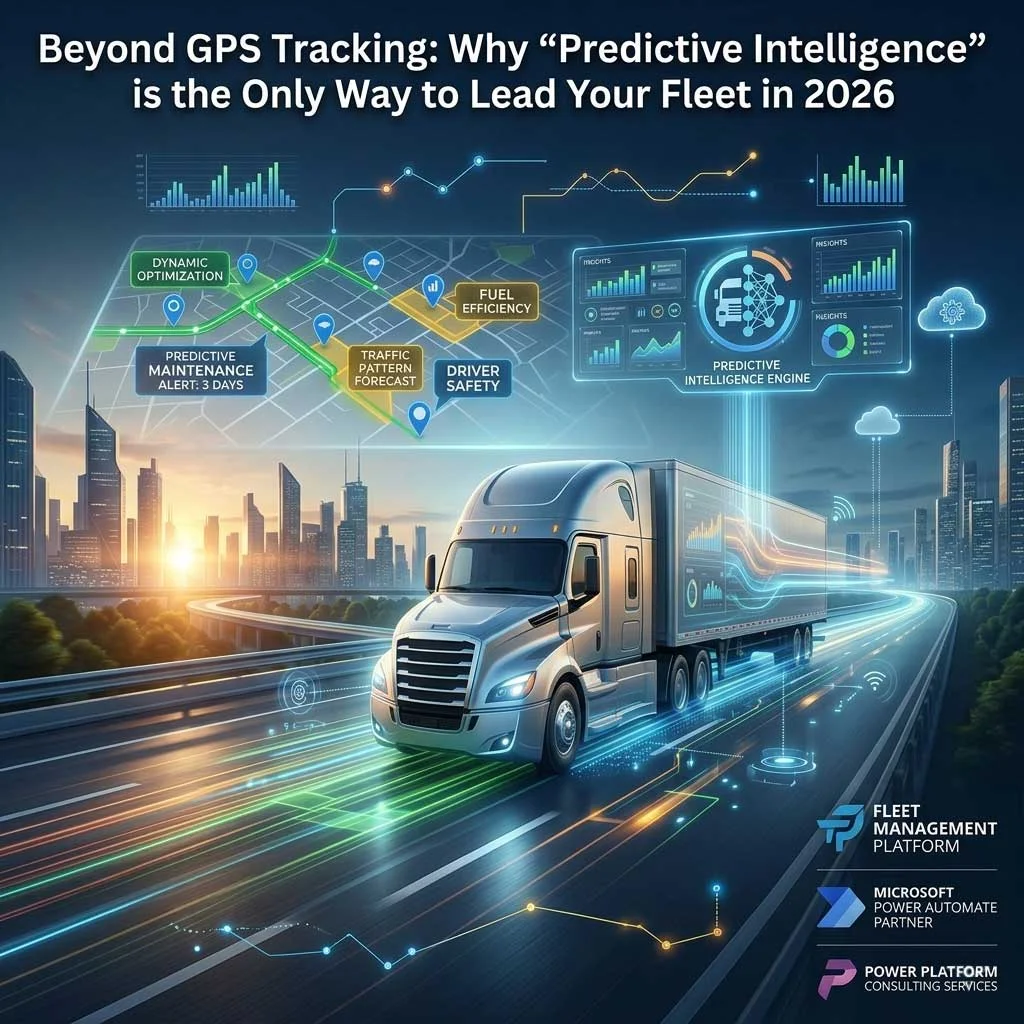
The “dot on a map” is dead.
If you are still patting yourself on the back because you can see your trucks moving in real-time on a screen, you aren’t leading a fleet. You’re watching a movie of your own obsolescence. In 2026, knowing where your assets are is a basic utility, like having electricity in your warehouse. It’s no longer a competitive advantage; it’s the bare minimum for entry.
The leaders who are currently dominating the logistics landscape have moved toward Predictive Intelligence. They aren’t reacting to delays; they are neutralizing them before they happen. They aren’t fixing broken engines; they are replacing parts three days before a failure occurs.
To survive this year and beyond, your strategy must shift from “What is happening?” to “What is about to happen?”
1. The 2026 Reality Check: GPS is Now a Commodity
A decade ago, GPS tracking was revolutionary. It gave us visibility. But visibility without foresight is just a front-row seat to a disaster.
In today’s hyper-volatile global economy, the variables have multiplied. We aren’t just dealing with traffic; we are dealing with micro-climate shifts, sudden port strikes, and fluctuating energy costs that change by the hour. Traditional GPS tells you that your driver is stuck in a three-hour backup. Predictive Intelligence told the driver to take a different route forty-five minutes ago because it analyzed a pattern of rising congestion and social media data regarding a local bridge closure.
If your tech stack only looks backward or at the present, you are driving a multi-million-dollar business while looking exclusively through the rearview mirror.
2. The Pillars of Predictive Intelligence
To build a fleet that thinks ahead, you must master three core pillars:
I. Predictive Maintenance: The End of the “Check Engine” Light
Scheduled maintenance is inherently wasteful. You either replace parts too early (wasting money) or too late (losing a vehicle for days). By leveraging IoT sensors and machine learning, modern fleets use “Just-in-Time” repairs. Your fleet management platform monitors vibration patterns, heat signatures, and oil viscosity in real-time.
The $100k Save: Imagine a long-haul carrier moving temperature-sensitive pharmaceuticals. The system detects a 0.5% variance in the refrigerator unit’s power draw—a sign of imminent compressor failure. The driver is rerouted to a service hub 10 miles away. Total cost: $400 for a relay. The alternative? A $120,000 loss in spoiled cargo and a ruined reputation.
II. Dynamic Route Optimization
The static routes of 2024 are gone. 2026 routes are living organisms. They ingest data from weather satellites, port telemetry, and even local event schedules. Predictive Intelligence calculates the “Total Cost of the Mile,” factoring in not just distance, but idling time, fuel burn rates at specific inclines, and the likelihood of a delay.
III. Driver Retention & Safety
The industry still struggles with driver shortages. Predictive tools now analyze behavioral data which is not to “spy” on drivers, but to support them. By identifying patterns of fatigue or erratic braking, you can intervene with a mandatory rest break before an accident occurs or before a frustrated driver decides to hand in their keys.
3. The Tech Stack of the Future: Microsoft’s Secret Weapon
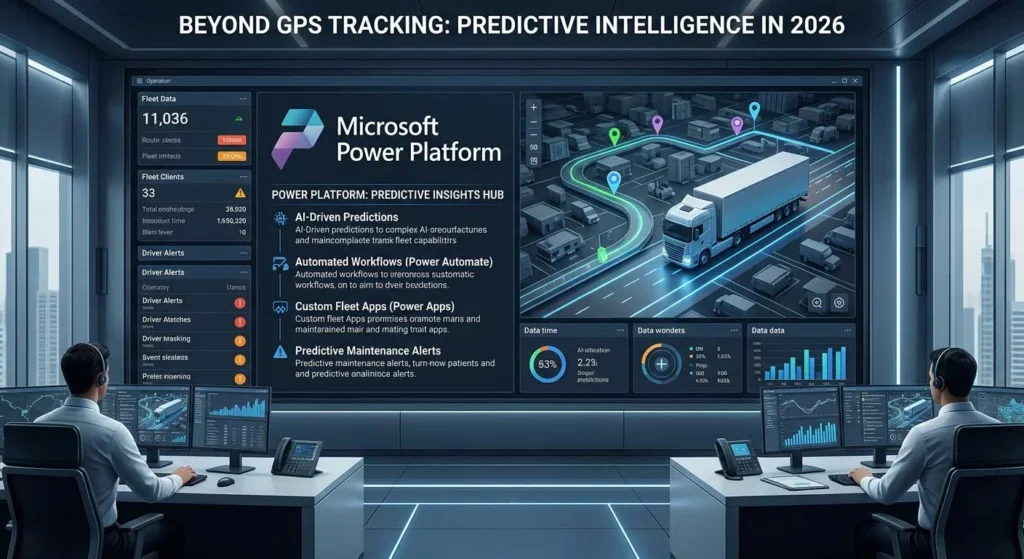
You don’t need to build an AI from scratch. You need an ecosystem that talks to itself. This is where the integration of a unified fleet management platform with the Microsoft ecosystem becomes a game-changer.
Customization via Power Platform Consulting Services
Off-the-shelf software often fails because your fleet has unique quirks. Maybe you specialize in last-mile delivery in dense urban cores, or perhaps you manage heavy-duty mining equipment. By utilizing power platform consulting services, you can build custom applications that sit on top of your data. These apps turn “big data” into “useful data,” providing dispatchers with a single pane of glass that highlights only the exceptions that need human intervention.
Automation with a Microsoft Power Automate Partner
Efficiency dies in the “manual gap” which is the space between a driver reporting an issue and a manager filing a ticket. Working with a Microsoft power automate partner allows you to bridge this gap entirely.
The Flow: An IoT sensor detects a brake pad wearing thin.
The Trigger: Power Automate instantly checks the inventory in the nearest hub.
The Action: A work order is created, a part is reserved, and a notification is sent to the driver’s mobile app to stop at Hub B at 4:00 PM. No emails, no phone calls, no human error.
4. The Economic Impact: ROI and the Carbon Mandate
In 2026, “going green” isn’t a PR move; it’s a fiscal necessity. Carbon taxes and strict emissions compliance are now standard.
Predictive Intelligence allows you to hit these targets by:
Reducing Deadhead Miles: Predictive load-matching ensures your trucks are rarely empty.
Fuel Hedging: Algorithms predict fuel price spikes in specific regions, instructing drivers where to refuel for maximum savings.
The ROI isn’t just in the money you make; it’s in the catastrophic expenses you avoid. Reactive fleets spend 30% more on emergency repairs and 15% more on fuel than their predictive counterparts.
5. Implementation Roadmap: Bridging the Gap
How do you move from a legacy GPS setup to a 2026-ready intelligence model?
The Data Audit: Evaluate your current sensors. Are they just sending location, or are they sending telemetry (engine health, fuel flow, tire pressure)?
Centralize the Hub: Move away from siloed spreadsheets. Ensure your fleet management platform can ingest third-party data.
Partner for Speed: Don’t let your IT department get bogged down. Find a Microsoft power automate partner to start automating the low-hanging fruit—like automated maintenance alerts and digital inspection logs.
Train for Insight: Shift your dispatchers’ mindsets. They are no longer “trackers”; they are “optimization specialists.”
Conclusion: Foresight is the Only Strategy
The data exhaust of your fleet is either a waste product or your most valuable asset. In 2026, the distance between the industry leaders and the laggards is measured in data points.
You can continue to watch your dots move across a map and hope for the best. Or, you can embrace Predictive Intelligence, leverage power platform consulting services to tailor your tools, and start leading your fleet with the certainty that only the future can provide.