











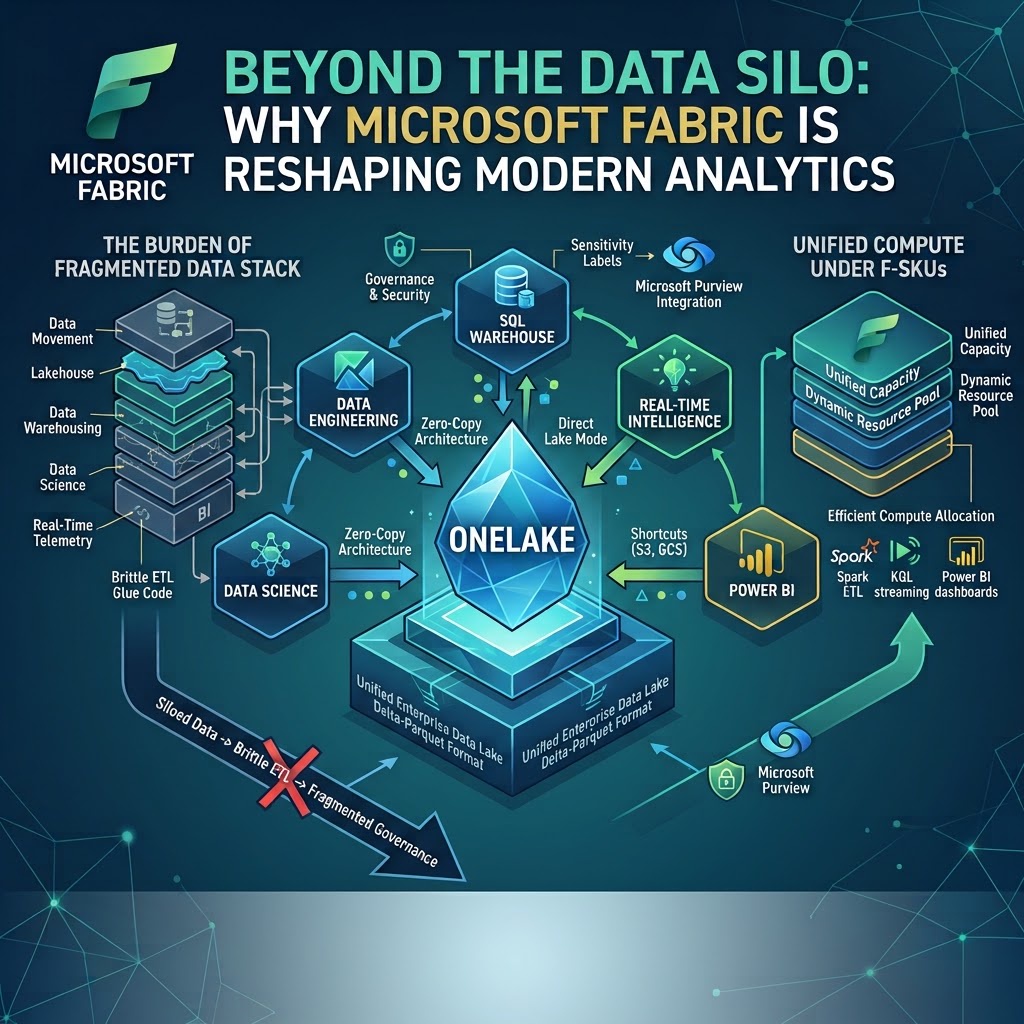
Enterprise data architectures have spent the last decade accumulating layers of accidental complexity. Typical analytics stack often juggles five disparate vendors: one for data movement, another for the Lakehouse, a third for data warehousing, plus separate platforms for data science, real-time telemetry, and business intelligence.
The result is continuous egress costs, brittle ETL glue code, fragmented governance policies, and engineering teams spending more time provisioning infrastructure than unlocking actual business insights. Microsoft Fabric directly tackles this architectural bloat by rethinking the data estate as an all-in-one, Software-as-a-Service (SaaS) ecosystem. By collapsing the boundaries between fragmented workloads, it forces a fundamental shift in how organizations store, compute, and consume their enterprise data.
The Burden of the Fragmented Data Stack
To understand the impact of Microsoft Fabric, one must look at the standard lifecycle of an enterprise data pipeline. Historically, data arrives in a landing zone, gets copied into a structured data warehouse via ETL (Extract, Transform, Load) pipelines, is duplicated again into a semantic layer for reporting, and is often exported once more into isolated environments for machine learning models.
Every single time data moves across these physical boundaries, businesses incur costs. They pay for network egress, they pay for the compute required to transform and move the data, and they pay for redundant storage to hold the same information in different formats (CSV, Parquet, proprietary database files). Beyond the financial toll, this fragmentation creates massive governance gaps. Row-level security applied at the warehouse layer must be manually recreated in the reporting layer. If a pipeline breaks, diagnosing the failure requires tracing logs across three different vendor platforms.
Fabric eliminates this integration tax by providing a unified environment where data engineering, data warehousing, data science, and real-time analytics share a single architecture and a single billing model.
The Core Shift: and Open Standards
At the center of Fabric is , built conceptually as the “OneDrive for your data”. Instead of copying data across separate operational silos for different departments or workloads, provides a single, unified enterprise data lake that spans the entire organization.
One of the most critical design decisions Microsoft made with Fabric is standardizing on the open Delta-Parquet storage format. Rather than locking enterprise data into proprietary database files, every engine in Fabric writes data in this open-source format.
The Zero-Copy Architecture
Because all Fabric workloads natively understand Delta-Parquet, the platform achieves true zero-copy architecture. Multiple compute engines. the SQL Data Warehouse, Apache Spark notebooks for data engineering, and Kusto Query Language (KQL) databases for Real-Time Intelligence operate directly on the exact same storage layer. A data engineer can use Spark to clean a massive dataset of streaming telemetry, and the moment that data is written to , a data analyst can query it using T-SQL, without any data movement or transformation pipelines required between the two environments.
Shortcut-Based Virtualization
Data migration is often the most significant barrier to adopting a new analytics platform. Fabric addresses this through Shortcuts. Teams can virtualize data from external cloud sources like Amazon S3, Google Cloud Storage, or external data lakes directly into . A shortcut acts as a metadata pointer, making external data behave as if it resides natively in . This allows organizations to query centrally without running complex, expensive migration pipelines to lift and shift petabytes of historical data into a new system.
Revolutionizing Business Intelligence with Direct Lake
For years, Power BI architects have had to choose between two imperfect storage modes. “Import mode” offered blazing-fast memory performance but required scheduling cumbersome dataset refreshes, leading to stale data. “Direct Query” offered real-time freshness by pushing queries back to the underlying database, but often resulted in sluggish dashboard performance as reports waited for the source system to compute the answers.
Microsoft Fabric solves this dilemma with Direct Lake mode. Power BI can now bypass traditional import refreshes and Direct Query latency by querying Delta tables in directly. Because the data is already stored in a heavily optimized columnar format (enabled by default via V-Order optimization), the VertiPaq engine can load the data straight into memory.
This delivers in-memory speed on billion-row datasets without duplicating data into a separate Power BI model. Furthermore, Direct Lake utilizes a mechanism called “framing” to ensure data freshness. Rather than reloading an entire dataset, Fabric monitors the Delta log. When an ETL process adds new data, Fabric updates the metadata pointers in the semantic model, bringing the new data into the report seamlessly and near real-time without interrupting ongoing queries. Performance optimization is no longer just about tweaking DAX formulas; it is now heavily tied to upstream Lakehouse design, file consolidation, and storage strategy.
Unified Compute Under a Single Capacity
Historically, budgeting for enterprise analytics required predicting isolated infrastructure SKUs: Synapse dedicated SQL pools, Databricks compute clusters, Analysis Services instances, and Power BI Premium nodes. If the data engineering team maxed out their Spark cluster overnight, the unused compute sitting in the Power BI Premium node couldn’t help them.
Fabric consolidates this fragmentation with a single pooled capacity model known as F-SKUs. Whether a team runs an intensive midnight Apache Spark ETL job, ad-hoc streaming analytics via KQL, or daytime Power BI dashboard consumption, all workloads draw from the exact same dynamic resource pool.
This shared compute model drastically simplifies cloud spend management. Compute capacity that is unused by BI consumers at 2:00 AM can be seamlessly allocated to heavy batch processing jobs, minimizing idle capacity waste. Furthermore, storage and compute are billed separately; storage costs are based on standard Azure Data Lake Storage Gen2 rates, while the F-SKU dictates the compute power.
Seamless Ecosystem Integration: Power Platform and Microsoft 365
Fabric’s architecture doesn’t exist in a vacuum; its true power unlocks when integrated with the broader Microsoft ecosystem. The ability to seamlessly push analytics into daily operational workflows transforms Fabric from a passive reporting tool into an active driver of business processes.
Organizations frequently utilize power platform consulting services to build custom Power Apps and Power Automate workflows that trigger based on insights generated within Fabric. For example, if a Fabric machine learning model detects an impending supply chain shortage, a Power Automate flow can instantly alert procurement teams in Microsoft Teams and automatically draft a purchase order in Dynamics 365. The integration is native, meaning developers can build business applications directly on top of the data processed in Fabric without building intermediate APIs or custom connectors.
Similarly, collaboration is heavily streamlined through Microsoft 365. Many enterprises rely on a SharePoint consulting company to manage massive intranets and document repositories. With Fabric, SharePoint data and Excel files can be natively tapped as data sources, while rich Power BI reports built on data can be embedded directly into SharePoint portals or Teams channels. This brings the data securely to where the users actually work, breaking down the traditional wall between operational document management and backend analytics.
Centralized Governance and Microsoft Purview
Data governance in fragmented architecture is a nightmare for Chief Data Officers. Setting up access controls in a data lake, redefining them in the data warehouse, and mapping them out again in the reporting layer introduces massive risk for human error and data leakage.
Fabric integrates natively with Microsoft Purview to provide built-in data discovery, classification, and lineage tracking. Because there is only one logical copy of the data in , governance policies only need to be applied once. You can apply unified sensitivity labels and access controls at the level, and those rules automatically propagate to every downstream tool. If a column containing personally identifiable information (PII) is masked in , it remains securely masked whether a data scientist accesses it via a Spark notebook or a sales manager views it in a Power BI dashboard.
Where to Start: A Pragmatic Migration Path
Adopting Fabric does not require a massive, high-risk “rip-and-replace” project that halts current operations. Because of its interoperability, most teams find traction by targeting high-friction bottlenecks and migrating iteratively.
A pragmatic approach often begins at the reporting layer. Organizations can eliminate Power BI refresh bottlenecks by moving heavy semantic models to Direct Lake, immediately reducing the load on source systems and providing users with faster dashboards.
Next, data engineers can focus on replacing multi-hop ETL pipelines. Instead of building complex Azure Data Factory pipelines to move data from an external AWS S3 bucket into an Azure SQL database, they can simply create an Shortcut. The data stays in AWS, but can now be queried by Fabric’s SQL endpoint as if it were local.
Finally, organizations can streamline governance by rolling out Purview policies over the newly centralized ecosystem.
By collapsing the boundary between data engineering, machine learning, and business reporting into a single platform, Fabric allows engineering teams to stop playing systems integrator. When teams no longer have to spend hours managing credentials across five different platforms, writing custom APIs to move data between them, or troubleshooting failed nightly loads, they get back to their actual purpose: delivering measurable business value from data.