










1. INTRODUCTION: Beyond the Siloed Software Trap
For over two decades, enterprise IT architecture has been dominated by a fundamental, artificial dichotomy: the separation of Customer Relationship Management (CRM) and Enterprise Resource Planning (ERP). This structural division treated front-office revenue generation and back-office cost control as two entirely separate worlds, requiring distinct software suites, disparate database schemas, and isolated operational philosophies. In this legacy paradigm, the front office was fast-paced, fluid, and customer-centric, while the back office was rigid, transactional, and focused on regulatory compliance, inventory ledger accuracy, and financial governance.
This “CRM vs. ERP” mindset is a relic of 2010s technical limitations. During that era, the underlying hardware, network bandwidth, and database technologies were incapable of handling high-velocity relational customer data and heavy transactional financial ledgers simultaneously within a single global repository. Organizations were forced to accept application-centric architectures, buying “best-of-breed” standalone software packages for sales, marketing, human resources, supply chain management, and core accounting.
However, this fragmentation introduced a severe structural friction. When customer-facing teams operate in complete isolation from the transactional and logistical realities of the back office, operational efficiency collapses. Sales pipelines become decoupled from supply chain capacity; customer service agents remain blind to billing disputes handled by finance; and executives are left trying to steer the enterprise using fragmented, contradictory reports generated weeks after business events occur.
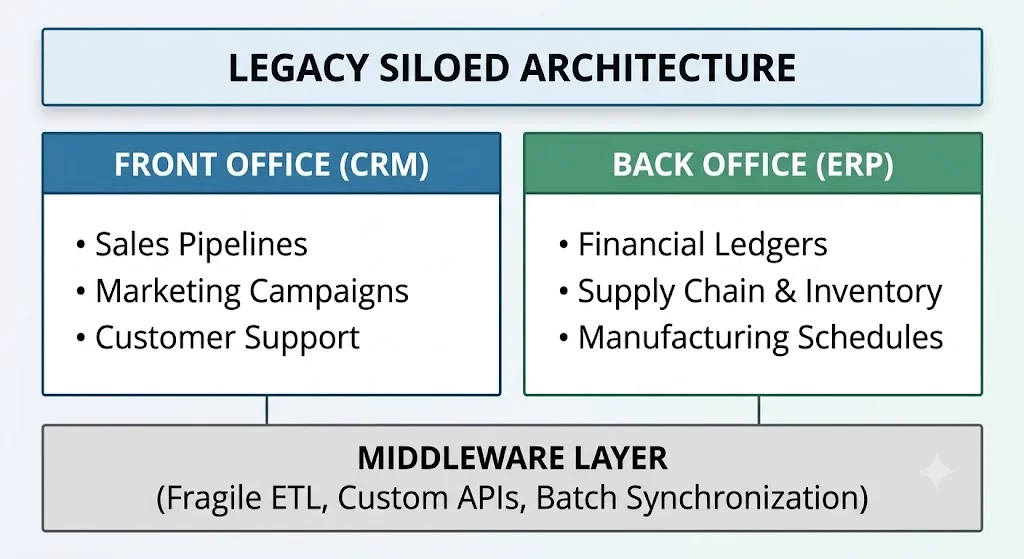
True operational velocity does not come from simply buying faster point solutions or piling on more integrations. Modern enterprise efficiency belongs exclusively to organizations that dismantle the application-centric model entirely and unify their data model on a single, shared relational layer. By placing a common data platform at the absolute center of the enterprise strategy, the artificial boundary between front and back-office systems evaporates, paving the way for autonomous, real-time business operations.
2. THE MIDDLEWARE TAX: The Hidden Financial and Technical Strain of Siloed Systems
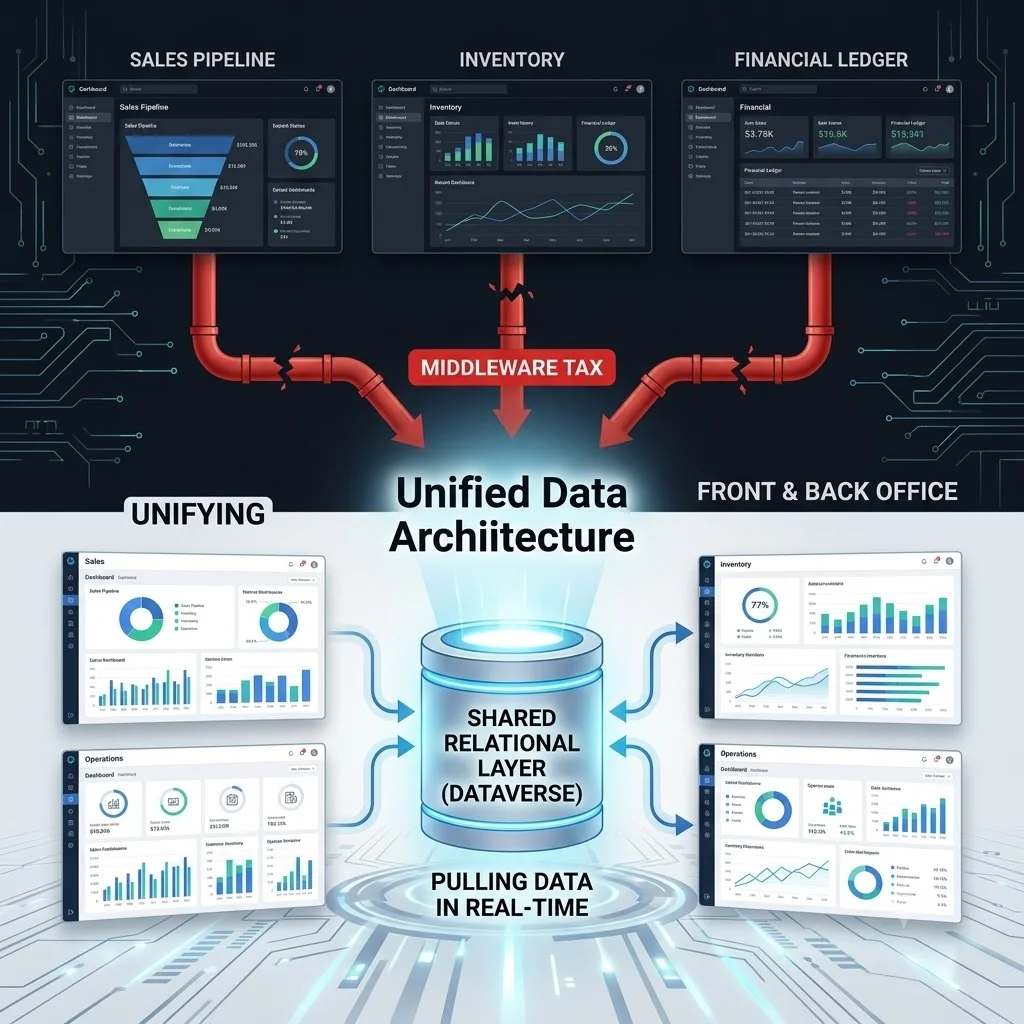
When an enterprise deploys separate, disconnected software systems for its front and back offices, it must inevitably build technical bridges to keep them aligned. This structural patch is known as the Middleware Tax—the massive, ongoing financial and technical burden of maintaining complex integration pipelines just to perform basic operational workflows, such as mapping a won customer account to a billing ledger.
The Complexity and Fragility of Integration Pipelines
To move data between disparate applications, enterprises typically construct a precarious web of middleware infrastructure, including:
- Extract, Transform, Load (ETL) Batch Processes: Scheduled jobs that run nightly or hourly to copy data from one database, restructure it, and inject it into another.
- Custom Enterprise Service Bus (ESB) Deployments: Heavy, centralized messaging systems designed to route events between systems via complex XML or JSON transformations.
- Point-to-Point Webhooks and Custom REST APIs: Brittle code scripts written by internal developers or external consultants to sync specific fields across application boundaries.
Every single point of integration represents a potential failure vector. Because these systems are fundamentally built on completely different data models, a simple action like updating a customer address requires complex field-mapping logic. If the CRM represents a customer name as a single string field (FullName), but the ERP splits it into three distinct tables (FirstName, MiddleName, LastName), the middleware must execute continuous structural translations.
Data Lag, Schema Drift, and Operational Downtime
The architectural consequences of this approach are highly destructive to real-time enterprise operations:
-
Data Lag: Because synchronous, real-time API calls across separate platforms are computationally expensive and prone to timeout failures, most middleware relies on asynchronous batch processing. This introduces an inherent data lag—often ranging from 15 minutes to 24 hours. Consequently, account managers look at stale financial statuses, and finance teams review outdated pipeline forecasts.
-
Schema Drift: Enterprise software is never static. When the CRM vendor pushes an automatic cloud update that alters an underlying data type, or when an internal team adds a custom field to the sales opportunity entity, the middleware pipeline instantly breaks. This phenomenon, known as schema drift, causes silent sync failures, unhandled exceptions, and immediate data corruption across systems.
-
Sync Failures and Conflict Resolution: When a customer record is modified simultaneously in both the CRM and the ERP, the middleware faces a split-brain scenario. Determining the “source of truth” requires complex, arbitrary conflict-resolution rules. When these rules fail, records lock up, queues back up, and IT teams must spend hundreds of hours manually reconciling databases.
The Strategic Failure of Isolated ERP Selection
This architectural friction is especially visible during regional digital transformation projects. For example, when enterprises look to modernize their operations in rapidly growing commercial hubs, they often search for the best erp software in Dubai to anchor their digital transformations. However, many of these organizations select an isolated ERP system based solely on its standalone financial and localized localization capabilities, ignoring its structural separation from the rest of the business ecosystem.
No matter how advanced an ERP platform is at managing balance sheets or regional tax compliances, if its underlying data engine is fundamentally isolated from the customer-facing applications, the investment fails to deliver its full value. The organization remains trapped in a cycle of paying the Middleware Tax, spending a significant portion of its IT budget on maintaining fragile connectors to bridge the gap between their new ERP and their existing CRM tools. True operational modernization requires a clean break from this siloed model, shifting toward platforms that share a native data layer out of the box.
3. UNIFYING THE FRONT AND BACK OFFICE: Real-Time Operational Convergence
To eliminate the Middleware Tax entirely, modern enterprise design requires shifting from an application-centric view to a data-centric view. In this unified data architecture, applications are no longer isolated silos holding their own independent databases. Instead, applications become modular, functional lenses sitting on top of a single, shared, relational data repository.
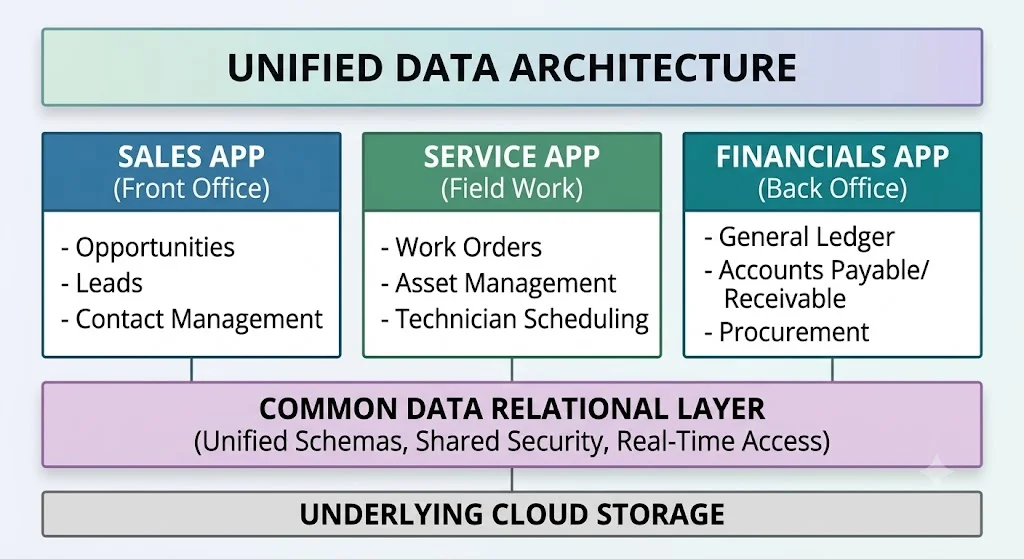
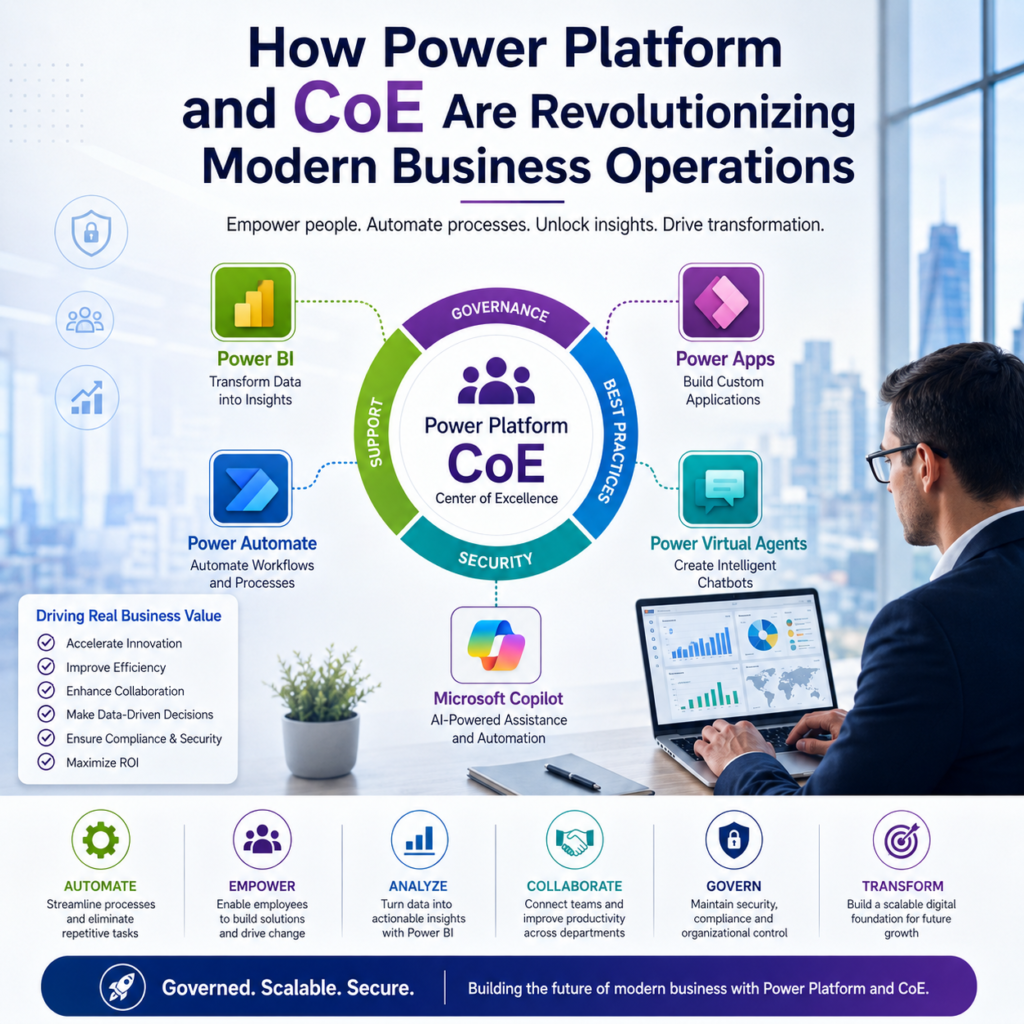
A prime example of this design is found in the Microsoft Power Platform and Dynamics 365 ecosystem, driven by Microsoft Dataverse. Dataverse is not a simple database; it is an intelligent, secure, relational data platform that natively employs a standardized data model known as the Common Data Model (CDM). When an organization runs its front-office sales applications and its back-office transactional engines on this single repository, the concept of data integration becomes completely obsolete. There is no data to transfer, copy, or transform because both systems read from and write to the exact same physical and logical tables in real-time.
Real-Time Transactional Visibility Across the Enterprise
When the front and back office share a single relational data layer, transactional realities from the deep back office feed directly into frontline sales tools instantly. This real-time visibility transforms how organizations operate:
-
Live Invoice and Credit Monitoring: Sales representatives can view the exact payment status of an account, including outstanding invoices and real-time credit limits, directly inside their primary sales interface before pitching an expansion deal.
-
Dynamic Inventory and Manufacturing Alignment: Instead of relying on a nightly batch export of warehouse stock levels, sales applications can read live inventory ledgers, physical asset locations, and real-time manufacturing queue capacities.
-
Unified Security and Compliance: Security policies, role-based access controls (RBAC), and data masking are applied directly at the data layer. If a user does not have permission to view a customer’s credit score in the finance application, that restriction automatically carries over if they try to access the same record through a sales application or a custom portal.
Practical Enterprise Scenario: Preventing Delivery Friction
Consider a large-scale industrial manufacturing and distribution enterprise operating across multiple territories. A senior sales representative is on-site with a tier-one client, preparing to close a high-volume order for custom components worth $500,000.
| Operational Vector | Legacy Siloed Architecture | Unified Data Architecture |
| Inventory Verification | Representative reviews an offline spreadsheet or a CRM field updated via a nightly ETL batch job. | Representative runs a real-time query directly against the production engine ledger within their sales tool. |
| Capacity Assessment | Sales team assumes capacity exists, signs the contract, and pushes the order down the pipeline. | System calculates raw material availability and active factory floor capacity in real-time. |
| The Result | Two days later, production reveals a material shortage. The delivery date slips, damaging the client relationship. | The system flags a bottleneck and suggests a delayed delivery date or alternative sourcing before the contract is signed. |
Architectural Insight: Unifying the data layer shifts an organization from a reactive posture to a proactive one. By embedding back-office constraints directly into front-office business tools, companies prevent operational friction before it ever reaches the customer.
Strategic Cloud Ecosystem Ecosystems in the Middle East
Across highly competitive regional markets, enterprises are realizing that deploying standalone point solutions is an outdated approach. Forward-thinking organizations are actively working with authorized UAE microsoft partners to deprecate their legacy, highly customized application integrations.
Instead, they are implementing unified cloud architectures that natively bring together their CRM datasets, supply chain ledgers, and operational tools onto a single platform. These authorized regional integration specialists help organizations safely migrate complex legacy systems into unified environments, ensuring that every business unit operates with a single, uncompromised source of truth.
4. BEYOND STANDARD PLATFORMS: Extending the Core with Low-Code and Analytics
A unified data architecture does more than just align standard out-of-the-box CRM and ERP applications. Its biggest benefit is how it transforms custom software development and advanced corporate analytics across the enterprise.
Side-Stepping Platform Lock-In via Low-Code Extensions
Historically, when an organization needed a bespoke application to solve a unique operational problem, it faced a difficult choice: build a custom extension inside the CRM platform, construct a heavy customization inside the ERP system, or write a standalone full-stack application from scratch. Each option required complex security configurations, expensive specialized developers, and the creation of yet another set of custom APIs to sync data back to the core engines.
With a unified relational layer, this platform lock-in disappears. Because all business data—from raw sales leads to final ledger entries—resides within a shared repository, corporate IT teams can use low-code application frameworks to build tailored desktop and mobile tools rapidly.
For instance, a field inspection team needs a mobile app to check machinery at a client site, log wear-and-tear metrics, and immediately trigger an upsell opportunity if parts need replacing, while also checking parts availability in the warehouse.
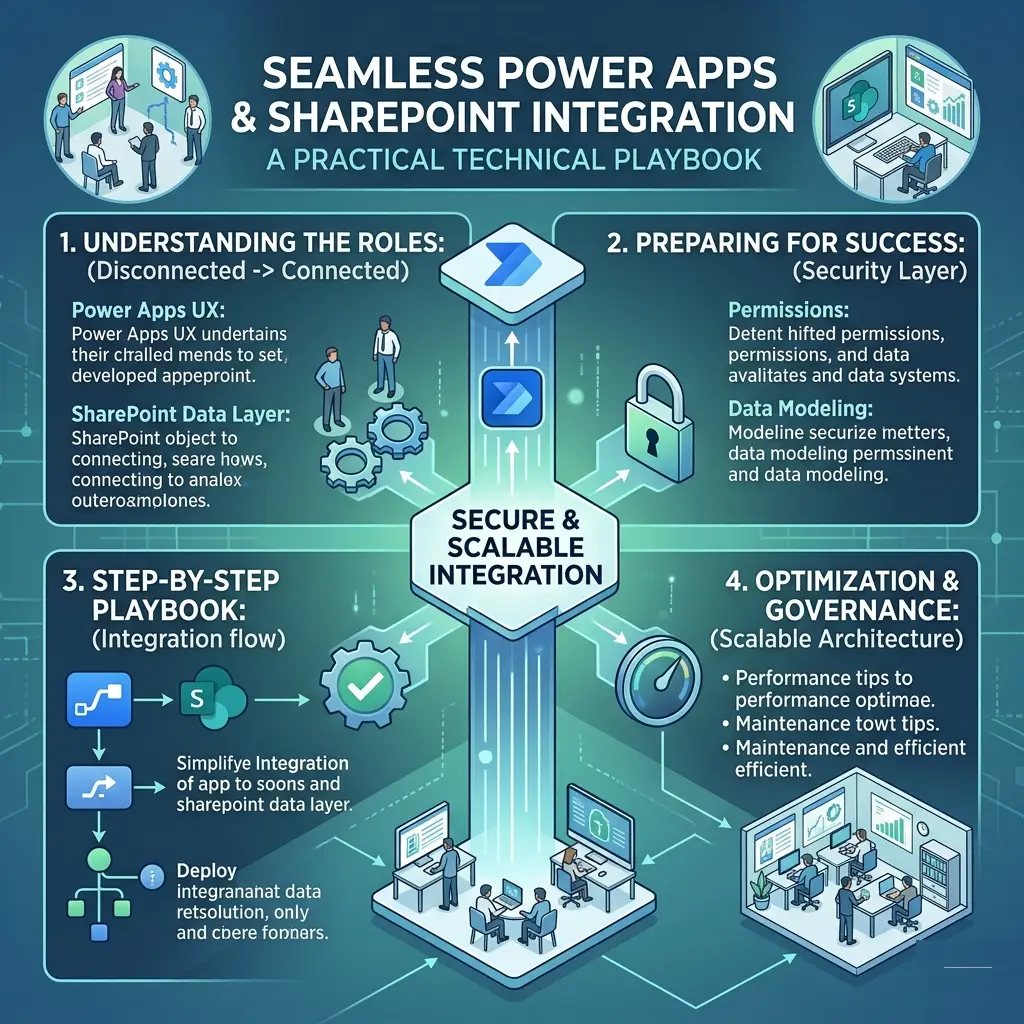
In a legacy environment, this requires weeks of integration work. In a unified architecture, developers can build a native low-code app in days using pre-built canvas components. The app reads and writes data directly to the central data engine, honoring all established enterprise security rules without needing any custom API connectors.
Accelerating Advanced Corporate Analytics
The traditional approach to enterprise reporting is notoriously slow and inefficient. To build an executive dashboard that shows performance across both sales pipelines and financial sheets, organizations typically have to build an extensive data warehousing pipeline:
-
Data is extracted from the CRM database and the separate ERP database.
-
The data is pushed into a temporary data lake staging area.
-
Data engineers execute complex transformation scripts to match disparate customer IDs across the two sets.
-
The cleaned data is finally loaded into an analytical data warehouse for reporting.
This pipeline is expensive to maintain, highly vulnerable to structural changes, and introduces significant data lag, meaning executive dashboards only show historical data that is days or weeks old.
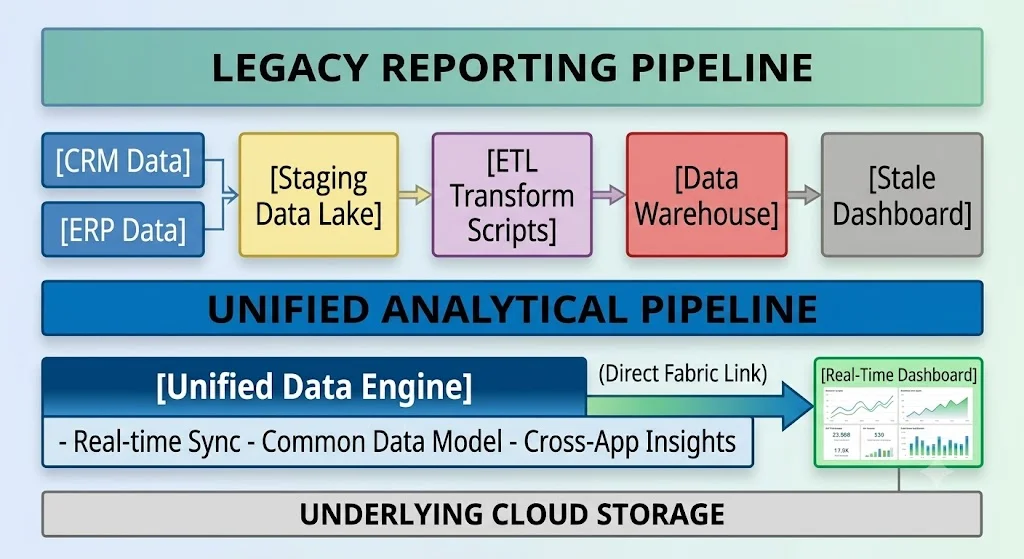
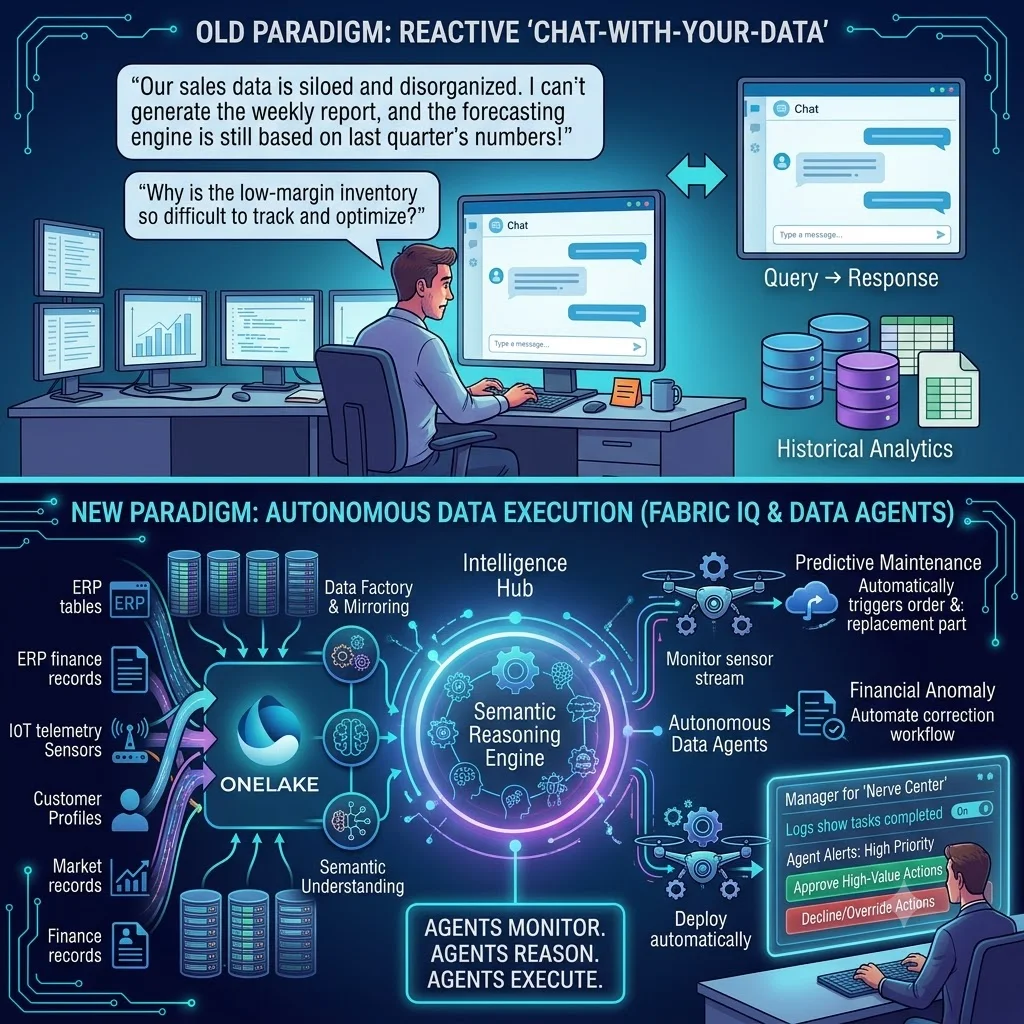
A unified data engine completely changes this workflow. Because the data is already standardized and structurally linked at the core, organizations can bypass the heavy ETL pipeline entirely. Leveraging modern analytics integrations, such as Microsoft Fabric, the central repository can stream data directly into analytical tools without moving or copying the data.
Executing a comprehensive microsoft power bi implementation on top of a unified data architecture allows organizations to build real-time executive dashboards that instantly analyze active pipelines alongside actual financial sheets. Leaders can slice data by geography, product line, or account tier, viewing live sales forecasts right next to actual cash flow and invoice aging metrics.
To scale these capabilities effectively, enterprises are increasingly utilizing specialized power platform services in UAE to deploy production-ready analytics and low-code suites. These localized experts ensure that data models are highly optimized for fast analytical queries, allowing executive teams to shift from retroactive reporting to predictive, real-time business steering.
5. CONCLUSION & STRATEGIC BLUEPRINT
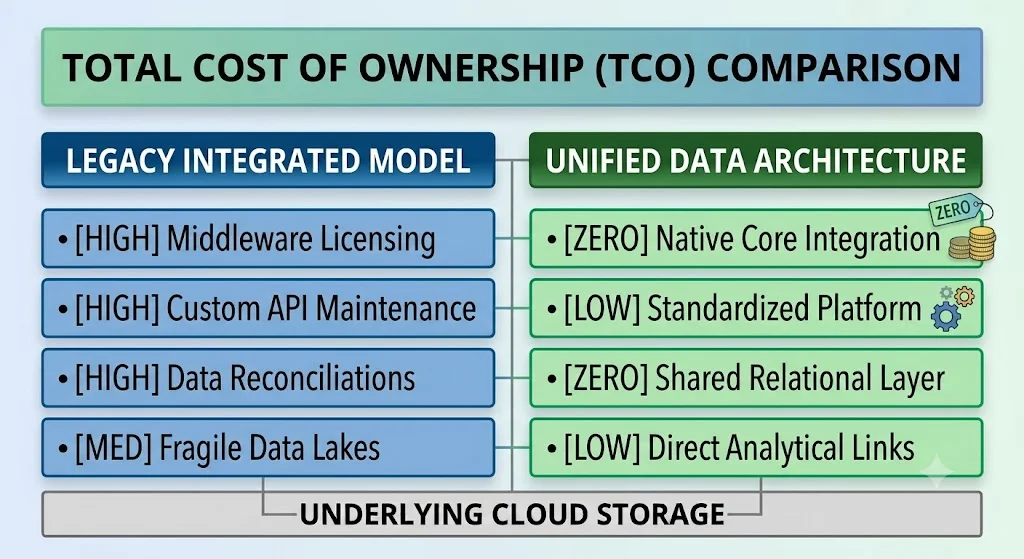
The long-term Total Cost of Ownership (TCO) benefits of a unified data architecture compared to traditional multi-vendor integrations are definitive. By eliminating the Middleware Tax, enterprises significantly reduce their direct software licensing costs for third-party connectors, slash the overhead spent on specialized integration developers, and practically eliminate the operational downtime caused by data sync failures and schema drift.
More importantly, it frees the organization from the hidden costs of bad data—such as lost sales from incorrect inventory records, delivery delays from poor visibility, and slow executive decision-making caused by fragmented reporting.
For enterprise technology executives evaluating a comprehensive infrastructure overhaul, the transition away from application-centric silos should be executed via a structured, risk-mitigated strategy.
Step 1: Execute a Comprehensive Data-Silo Audit
Before selecting or deprecating any software applications, IT leaders must thoroughly document every active data silo, point-to-point API connector, and batch ETL pipeline currently running across the organization. This audit should explicitly quantify the total cost of ownership of the current infrastructure, including direct middleware subscription fees, developer maintenance hours, and the estimated financial impact of historical sync failures and data inaccuracies. This establishes a clear financial and technical baseline for the transformation project.
Step 2: Establish a Standardized Core Data Schema
Organizations must transition away from buying applications based purely on user-interface features, shifting focus to the underlying data architecture. The enterprise should select a core data platform that features a standardized, extensible relational schema—such as the Common Data Model used by Microsoft Dataverse. This central schema must serve as the absolute source of truth for foundational data entities, ensuring that customer accounts, financial ledgers, and operational product tables are natively connected at the lowest architectural layer.
Step 3: Implement an Incremental, Value-Driven Migration
Migrating completely to a unified data architecture does not require an risky, all-at-once software replacement. Executives should leverage an incremental migration strategy, starting with a single high-impact operational vector—such as connecting front-office sales quoting directly to back-office inventory ledgers. By moving one business capability at a time onto the shared data layer, the enterprise can systematically eliminate legacy middleware connections, validate the unified security and data models in real-world scenarios, and deliver immediate operational value back to the business without disrupting daily enterprise workflows.